
Husqvarna Technical, 40/42
$137.99 at Amazon
Check it on AmazonPrice as of Oct 22, 2026, 3:25 AM EDT
Why it’s our pick
Four UL-certified chaps, the size that fits you, and how to keep them working.

As an Amazon Associate I earn from qualifying purchases.
Get the Husqvarna Technical Apron Wrap: UL certified, five layers, a 1000-denier coated shell and a wrap that stays put. Amazon stocks the 40/42 length; for shorter legs, get the Notch in 32 or 36 inches.


Product prices and availability are accurate as of the date/time indicated and are subject to change. Any price and availability information displayed on Amazon.com at the time of purchase will apply to the purchase of this product.
Our spec score runs every pair through the same nine checks from the makers’ own pages: certification, standards named, protective layers, shell, wrap, waist range, length choices, pocket and care instructions. The method is at the bottom of the page.
Prices and availability are accurate as of the time shown and may change.
You’re 6 feet or taller, cut regularly through brush and limbs, and want the heaviest shell here on a pair of chaps that wraps the leg.
Your waist-to-boot measurement is under about 38 inches. Get the Husqvarna Functional or the Notch in your size.
The Husqvarna Technical Apron Wrap is the pair we’d buy for most people who run a saw often. It scores 9.0, the top of our four. Husqvarna calls it an apron wrap chap, and it’s the only pick here built that way; the other three are frontal aprons.
The protection is five layers of Husqvarna’s TEK WARP material under the shell. Husqvarna describes it as a pull-apart design: when a running chain touches the chaps, the fibers pull out and clog the saw’s sprocket, which slows or stops the chain. That’s the same idea the U.S. Forest Service describes for its own chaps, where pad fibers jam the drive sprocket.
The shell is where this pair beats Husqvarna’s own Functional model. It’s 1000-denier polyester with a PVC coating, against 600-denier on the Functional, the Notch and the Oregon. The Forest Service’s guide says a damaged shell lets bar oil soak into the pad, and oil acts like glue that cuts protection. A tougher outer layer is the first defense against that.
On paper, it’s the most complete pair here. Husqvarna says it meets ASTM F1897 and ANSI Z133.1, is UL certified, and meets OSHA regulation 1910.266. Its three named standards tie the Functional for the most here, and the shell and wrap put it on top. It also has a felling wedge and gear pocket and Acetal Delrin buckles, and the waist adjusts up to 42 inches.
Length is the catch. Husqvarna makes it in 36/38 and 40/42, measured from waist to ankle. On Amazon, the 40/42 is the size that was in stock when we checked; the 36/38 listing had no offer. If your measurement is under about 38 inches, the 40/42 will run long, so use our length finder first.
Care is simple and written down. Husqvarna says to wash in cold water with mild detergent, hang to dry, and never use chlorine bleach. The Forest Service gives the same warning about bleach, which it says lowers cut-through protection.
Prices and availability are accurate as of the time shown and may change.
You’re shorter or taller than average, or your waist is over 42 inches, and you want a size made for your measurement instead of one size cinched to fit.
You want a wrap design or the toughest shell. The Husqvarna Technical has both.
The Notch Apron Style chaps are the pick for getting the fit right. They score 8.5. Notch makes them in three lengths, Medium at 32 inches, Large at 36 and X-Large at 40, measured on the outseam from the top of the waistband. No other pick here offers three.
The waist range is the widest of the four. Notch’s two-inch belt adjusts from 28 to 48 inches, and the legs close with one-inch straps and quick snap fasteners. There’s also an optional folding waistband with buttons. The Forest Service says snug chaps stay positioned correctly on your legs, and straps you can tighten are how you get there.
Notch says the chaps are UL certified to ASTM F1897-20 and meet OSHA’s 1910-266 leg protection standard. Its product page spells the standard F1987 in two places; the Amazon listing and the standard itself are F1897. The coverage is what Notch calls Type A: ankle to crotch, on the front of the leg.
Inside are five layers of what Notch calls technical lightweight chain-stopping material, a poly and polypropylene blend. The shell is 600-denier Oxford polyester, water and oil resistant. On the front, a left-side Velcro pocket holds a felling wedge. The color is hi-vis safety orange, which makes you easier to see in the brush.
It drops behind the Husqvarna Technical on three checks. The shell is 600-denier, not 1000. It’s a frontal apron, not a wrap. And Notch names two standards, not three. Care is hand wash only, hang to dry, with no bleach or harsh detergent, per Notch.
When we checked, the Amazon seller was SHERRILLtree, an arborist supply dealer. All three sizes were new and in stock when we checked. Pick your size with our length finder; Notch says to measure the outseam from the top of the waistband.
Prices and availability are accurate as of the time shown and may change.
Your waist-to-boot measurement is 36 to 38 inches and you want Husqvarna’s certifications from a pair Amazon.com sells in that length.
The Husqvarna Functional Apron is the pair to get if you want Husqvarna and your legs are average length. It scores 8.4. Husqvarna sells it in 36/38 and 40/42, and the 36/38 is the size that was in stock on Amazon, which fills the gap the Technical leaves on Amazon.
Husqvarna describes it as a five-layer frontal apron chap: 600-denier polyester with a PVC coating over TEK WARP protective layers. It has a felling wedge pocket and Acetal Delrin buckles, and the waist adjusts up to 42 inches. It names the same standards as the Technical: ASTM F1897, ANSI Z133.1, UL certified, and OSHA 1910.266.
Against the Technical it gives up two things. The shell is 600-denier rather than 1000, and the cut is a frontal apron rather than an apron wrap. Both cost points on our score; neither changes the certification. If you mostly cut firewood in the open, a frontal apron covers the front of both legs, and that’s what you’re paying for.
That point is worth knowing. Because people run the saw with the right hand, the Forest Service says most chain contact injuries are on the left leg, and its own redesign added coverage on the left side of each leg. Look at how a pair sits on your left thigh when you try it on.
One thing to check before you order. The Amazon listing says the waist adjusts to 38 inches with a 32-inch inseam, while Husqvarna’s page says the waist goes to 42 and the 36/38 length runs from waist to ankle. We go by Husqvarna’s own page. If your waist is near 40, the Notch gives you more room.
Care matches the Technical: cold water, mild detergent, hang to dry, and never chlorine bleach. Husqvarna lists the Functional as fitting its chainsaws from the 120 to the 460 Rancher and the Power Axe battery saws.
Prices and availability are accurate as of the time shown and may change.
You want the most layers on this page, a waist up to 46 inches, and chaps you can put through the washing machine.
Your waist-to-boot measurement is over 36 inches. One size won’t reach; get the Notch XL or Husqvarna 40/42.
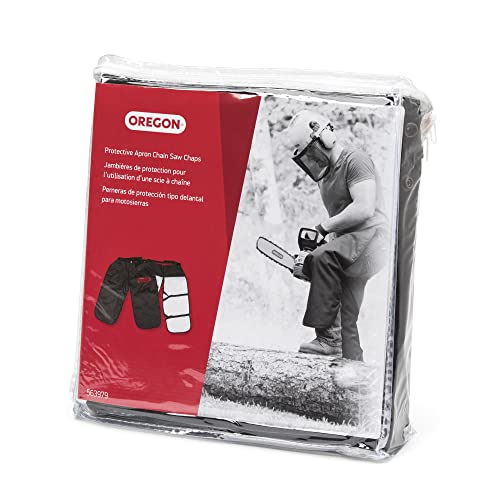
The Oregon 563979 is the simple one-size pair. It scores 7.7. Oregon makes saw chain and bars, and its product page lists these as one-size protective apron chaps with a 36-inch universal length and a waist that adjusts up to 46 inches.
It has the most layers here: eight layers of breathable warp-knit protective mesh, against five on the Husqvarna and Notch pairs. Layer counts aren’t a straight measure of protection, because makers use different materials. A tree-care trainer writing in TCIA’s magazine describes two families, long tech fibers that catch the chain and bulk batting that clogs the sprocket. Still, eight layers scores highest on our layer check.
Oregon says the chaps are UL classified to F1897-20; its page calls it ANSI F1897-20, and the standard is ASTM’s. That’s the only standard Oregon names, so it scores lowest on our standards check. The shell is 600-denier Oxford, which Oregon calls soft but durable.
Care is the reason to pick it. Oregon says the chaps are machine washable for repeated use. That’s the opposite of Husqvarna and Notch, who say hang dry and hand wash, and of the Forest Service’s rule for its own chaps. Follow the label on the pair you own. The TCIA trainer’s advice is to wash chaps so the inner material fluffs back up.
One size has limits. The 36-inch length shortens with snaps at the top, and Oregon doesn’t say by how much. If your measurement is over 36 inches, it won’t reach 2 inches below your boot tops, the Forest Service’s fit rule. Oregon doesn’t list a wedge pocket, which costs it 5 points.
Oregon lists the boxed weight at 3.35 lb. None of the other makers publish a weight, so we can’t compare it.
Every spec comes from the maker’s product page or its Amazon brand listing. Scroll sideways on a phone.
| Chaps | Photo | Score | Certified | Layers | Shell | Waist | Lengths | Buy |
|---|---|---|---|---|---|---|---|---|
| Husqvarna Technical Wrap that stays put | | 9.0 | UL, F1897 Z133.1, OSHA | 5 | 1000D PVC-coated | To 42 in | 36/38, 40/42 40/42 on Amazon | Check it on Amazon |
| Notch Apron Choosing your length | | 8.5 | UL, F1897-20 OSHA | 5 | 600D Oxford | 28 to 48 in | 32, 36, 40 in all on Amazon | Check it on Amazon |
| Husqvarna Functional 36 to 38 in legs | | 8.4 | UL, F1897 Z133.1, OSHA | 5 | 600D PVC-coated | To 42 in | 36/38, 40/42 36/38 on Amazon | Check it on Amazon |
| Oregon 563979 Machine washing | | 7.7 | UL, F1897-20 no others named | 8 | 600D Oxford | To 46 in | 36 in snap-adjustable | Check it on Amazon |
All four are apron-style chaps you wear over your work trousers, and all four makers say they’re UL certified or classified to ASTM F1897.
The Forest Service says chaps should reach 2 inches below your boot tops. Measure from your waist to that point, then pick it below. Each maker measures length from the top of the waistband down.
| Your measurement | Husqvarna | Notch | Oregon |
|---|---|---|---|
| 32 in or less | 36/38 runs long | M, 32 in | 36 in, snap shorter |
| 33 to 36 in | Functional 36/38 | L, 36 in | 36 in |
| 37 to 38 in | Functional 36/38 | XL, 40 in | Too short |
| 39 to 40 in | Technical 40/42 | XL, 40 in | Too short |
| 41 to 42 in | Technical 40/42 | Too short | Too short |
Measure in the boots you’ll cut in. Stand straight, run a tape from the top of your belt line down the outside of your leg to 2 inches below the boot top, and round up.
Forester’s sizing chart, from a brand we left out below, gives a rough check: its 35 to 37 inch Regular fits most people from 5 ft 4 in to 6 ft, and its 38 to 40 inch Long fits most from 6 ft to 6 ft 4 in.
Too short leaves your shin bare where the chain can reach. OSHA’s logging rule, written for employers, says leg protection must cover the full length of the thigh to the top of the boot. Too long and the hem catches on brush or your boot laces. A flip belt or snaps can take up a small gap, but neither fixes a size that’s wrong by four inches.
Chaps don’t deflect a chain like armor. The fibers inside pull out, wrap the chain and jam the saw’s drive sprocket, which slows or stops it.
The Forest Service has issued chaps to its sawyers since 1965 and tracked chain contact injuries since.
Its 2004 guide tells the story in one chart. The first four-layer ballistic nylon pad resisted a chain at 1,800 feet per minute; a Kevlar pad in 1981 raised that to 2,500 and cut the weight by 40 percent; the 2000 redesign reached 3,200 and added coverage on the left side of each leg.
The Forest Service describes how it works: fibers of the pad are pulled into the saw’s drive sprocket, causing the saw to jam. Husqvarna describes its TEK WARP chaps the same way, as a pull-apart design that clogs the sprocket.
The outer shell isn’t the part that stops a chain; the TCIA trainer notes the cover isn’t cut resistant. Its job is to keep oil, sawdust and water away from the layers underneath.
Slow or stop a running chain on contact, so a cut is shallower. The TCIA trainer calls them more like a bandage than a bulletproof shield.
Stop a chain you keep pushing into them. The same trainer says that if you keep pushing, the saw keeps cutting. The protection assumes you let go of the trigger.
The Forest Service says not to use chaps as a chain stop. Every cut, even a nick, shortens the fibers that do the stopping.
Every pick covers the front of both legs from the waist toward the ankle. The Husqvarna Technical adds a wrap around the lower leg; the other three are frontal aprons held on with leg straps.
| Style | Covers | Our picks | Good for |
|---|---|---|---|
| Frontal apron | Front of both legs, waist toward the ankle; open back | Notch, Husqvarna Functional, Oregon | Quick on and off over work trousers; firewood in the open |
| Apron wrap | Same front panel; Husqvarna’s photo shows it wrapping the lower leg | Husqvarna Technical | Brush and limbing, where a loose hem snags |
| Chainsaw pants | Sewn-in protection as full trousers | None here | All-day pros; hotter, and sized like trousers |
Notch calls its frontal coverage Type A: ankle to crotch, on the front. The back of the leg is open on every apron chap, which is why they’re cooler and quicker to put on than chainsaw pants.
The wrap matters for fit as much as coverage. The Forest Service says chaps should be snug so they stay positioned correctly on the legs; a panel that wraps the calf can’t swing around to the side when you kneel or climb over a log.
Four labels show up on chaps. One is the test standard, one is who checked it, and two are workplace rules. Look for the first two on the tag inside the chaps.
| Label | What it is | On our picks |
|---|---|---|
| ASTM F1897 | ASTM’s specification for leg protection for chain saw users: minimum design, performance, testing and certification requirements | All four; Forester’s listing says it meets the 2008 edition |
| UL certified or classified | An outside lab, UL, has certified the product to the standard, rather than the maker saying it meets it | Husqvarna, Notch, Oregon; not claimed by Forester |
| OSHA 1910.266 | U.S. logging rule: employers must give chain saw operators cut-resistant leg protection from thigh to boot top | Husqvarna, Notch; Forester |
| ANSI Z133.1 | The tree-care industry’s safety standard for arborist work | Husqvarna only |
The ASTM abstract says the standard covers fit and flexibility as well as cut resistance: garments have to let you move normally and keep working through seasonal weather. That’s why certified chaps aren’t just thick. Where a label says “meets ASTM F1897” with no UL mark, the maker is speaking for itself. We give full points only for the outside certification.
The Forest Service writes its own specification for the chaps it issues, MTDC 6170-4.
Nobody has a rating for it yet. Chaps work by jamming the sprocket, and one maker warns an electric motor’s torque may drive through that jam.
| Source | What it says about electric and battery saws |
|---|---|
| Forester (left out) | Its chaps “are not suitable protection for use with electric chainsaws, due to the high-torque nature of electric motors” |
| TCIA magazine, Jan 2022 | A trainer says there’s no rating for electric saws because the tests haven’t been done; in his demonstration, battery saws were stopped by the material |
| Husqvarna, Notch, Oregon | Their chaps pages don’t mention electric or battery saws |
| Husqvarna fit list | Lists the Functional chaps as fitting its Power Axe 350i and 225i battery saws, with no further claim |
Here’s how we read it. Chaps stop a chain by jamming the sprocket, and Forester’s worry is that an electric motor’s torque can keep driving through that jam. The TCIA trainer’s demonstration says chaps still slowed and stopped battery saws, but he also says no standard tests for it.
So wear chaps with a battery saw; they still put layers between the chain and your leg. Let go of the trigger the moment something goes wrong, and keep the chain brake working.
More layers usually means more fiber to catch the chain, but the material matters too, so read layer counts as one clue, not the answer.
| Chaps | Protective layers | Shell |
|---|---|---|
| Husqvarna Technical | 5 layers TEK WARP | 1000-denier polyester, PVC coating |
| Husqvarna Functional | 5 layers TEK WARP | 600-denier polyester, PVC coating |
| Notch Apron | 5 layers poly/polypropylene | 600-denier Oxford polyester, water and oil resistant |
| Oregon 563979 | 8 layers warp knit | 600-denier Oxford |
| Forester 437 (left out) | 4 ply | Oxford polyester, denier not stated; water and oil resistant |
Denier is the weight of the yarn in the shell; a higher number is a heavier, tougher weave. The shell doesn’t stop the chain, but the Forest Service says holes in it let bar oil soak the pad, and oil acts as an adhesive that holds the fibers in place. That’s the case for a coated, heavier shell if you work in oily, brushy conditions.
The pad inside is what matters most, and makers describe it differently. The Forest Service’s own chaps use five Kevlar layers, woven and felted. Notch’s five layers are a polyester and polypropylene blend. Oregon uses eight layers of warp knit. None publish a cut speed for the pairs here, so we score the certification, not a speed.
Follow your maker’s label. The four we checked don’t agree on the washing machine, but they all say no bleach.
| Maker | Wash | Dry | Never |
|---|---|---|---|
| Husqvarna | Cold water, mild detergent | Hang to dry | Chlorine bleach |
| Notch | Hand wash only | Hang to dry | Bleach or harsh detergent |
| Oregon | Machine washable | Not stated | Not stated |
| Forest Service (its own chaps) | Hose and brush, then a citrus cleaner | Line dry | Machine wash or dry, bleach, pressure washer |
Washing isn’t optional. The Forest Service says oil and dirt deposits that won’t come out leave chaps with much less protection. The TCIA trainer adds that chaps stuffed into a truck dirty and folded get matted, and matted fibers have less loft to grab a chain; washing lets the inner material fluff back up.
Keep them away from fuel and bar oil between uses. Repair shell cuts quickly, the Forest Service says, so sawdust and oil stay out of the pad, but never stitch through the protective layers.
The Forest Service’s guide for its own chaps lists when to retire them. It’s the clearest checklist we found, and it applies to any pair.
Numerous holes let bar oil reach the pad, and oil reduces protection.
Wood chips and sawdust in the layers at the bottom of the chaps.
Patches sewn through the pad stop the fibers moving, which lowers cut-through protection.
Bleach or a pressure washer. The Forest Service says high-pressure washing destroys the pad.
Deposits that won’t come out with cleaning. Tested chaps like this gave much less protection.
On Forest Service chaps, a cut over 1 inch in the first yellow Kevlar layer. On any chaps, a chain that reached the pad.
After any chain contact, look inside. If the fibers pulled out and jammed the saw, the chaps did their job and they’re done. The TCIA trainer explains why: those fibers run the full length of the leg, and once they’re cut short there’s less length to catch the next chain.
Chaps protect your legs. OSHA’s logging rule lists what else employers must provide to people who run a saw, and it’s a good homeowner checklist too.
| Gear | OSHA 1910.266 says | Our guide |
|---|---|---|
| Leg protection | Cut-resistant, full length of the thigh to the top of the boot | This page |
| Boots | Heavy-duty, supporting the ankle; cut-resistant for chain saw operators | None yet |
| Head | Where there’s potential for injury from falling or flying objects | None yet |
| Eyes and face | Eye protection where objects can fly; logger mesh screens allowed | None yet |
| First aid | A first-aid kit at each site where trees are being cut | First aid kits, tourniquets |
Hearing protection belongs on that list for any gas saw; our earmuff guide covers passive and electronic muffs. Work gloves with a good grip help too; see our Mechanix gloves guide.
A tourniquet belongs in the first-aid kit by the woodpile. The TCIA trainer points out that the femoral arteries on the inside of each thigh are as big as your thumb, and a cut there can bleed out in about three and a half to four minutes.
These are chaps people search for. Each one missed our 7.0 floor or a basic check, so we don’t recommend them here.
| Chaps | Score | What held it back | What it does well |
|---|---|---|---|
| Forester 437 apron chaps (CHAP437-O) | 6.5 | Says it meets ASTM F1897-2008 with no UL mark; 4 ply; shell denier and care instructions not published; Forester says not for electric saws | Three lengths, a 2 in flip belt, a pocket and a height chart |
| STIHL protective chaps (0000 886 3905) | Left out before scoring | Sold by a third party, and the listing gives only length and waist; STIHL’s US chaps page wasn’t reachable to check | 36 in length, 30 to 42 in waist |
| Zelarman 8-layer apron chaps | Left out before scoring | Little-known brand with no maker page to check, and only 6 left in stock | 8 layers, per the listing |
| Yardmaris Technical Wrap chaps | Left out before scoring | Little-known brand; claims come from the listing only | Wrap design, 8 layers, per the listing |
Look for UL certified or classified to ASTM F1897, not just “meets”.
Waist to 2 inches below your boot top, in your work boots.
Husqvarna goes to 42 in, Oregon 46, Notch 48.
Frontal apron for quick on and off; apron wrap if loose hems snag in brush.
A coated, heavier shell keeps oil and sawdust out of the pad.
Machine wash, hand wash or hang dry: you’ll do it often.
| Your situation | Look for | Our pick |
|---|---|---|
| You cut often and you’re tall | Apron wrap, 1000D shell | Husqvarna Technical |
| Short legs or a waist over 42 in | Three lengths, waist to 48 in | Notch Apron |
| Average length, want Husqvarna | 36/38 length | Husqvarna Functional |
| You want to machine wash them | Machine-washable label | Oregon 563979 |
| You want the most layers | 8 layers | Oregon 563979 |
| You run a battery saw | Any certified pair, and a working chain brake | Read this first |
Leg protection you wear over your trousers when running a chainsaw. Layers of long fibers under a tough shell pull out on contact with a running chain and jam the saw’s sprocket, which slows or stops the chain.
A shell of polyester or nylon, often coated against oil and water, over several layers of protective fiber. Husqvarna uses five TEK WARP layers, Notch five layers of a polyester and polypropylene blend, Oregon eight layers of warp knit, and the Forest Service’s own chaps five Kevlar layers.
For loggers, OSHA requires employers to provide cut-resistant leg protection to anyone running a saw. For homeowners there’s no law, but the risk is the same: the femoral arteries run down the inside of each thigh, and the Forest Service says its chaps have prevented thousands of serious injuries.
There’s no rating for it yet. Forester says its chaps aren’t suitable for electric saws because of their high torque. A TCIA trainer reports that battery saws were stopped by chaps in his demonstration. Wear them, and let go of the trigger at once.
Snug, so they stay in place, and long enough to reach 2 inches below your boot tops, per the Forest Service. Our length finder shows which size of each pick fits your measurement.
Yes, and you should. Follow the label: Husqvarna says cold water, mild detergent and hang dry; Notch says hand wash only; Oregon says machine washable. All say no bleach.
After any chain cut into the pad, or when the shell has many holes, sawdust is inside, oil won’t wash out, or someone has stitched a patch through the pad. Those are the Forest Service’s retirement rules.
None of the four makers we checked claim snake protection. They’re certified for chain contact only. If snakes are your worry, look for gaiters or chaps sold and tested as snake protection.
Chaps go on over your trousers in seconds and leave the back of the leg open, so they’re cooler. Chainsaw pants have the protection sewn in; they suit people who cut all day. For firewood and storm cleanup, apron chaps are the usual choice.
Plain Prepper is owned and edited by Isaac Daniels. Every spec on this page comes from the maker’s own product page or its Amazon brand listing, and the fit, care and retirement advice from the U.S. Forest Service, OSHA and the Tree Care Industry Association, named in the sources below. We don’t run cut tests, so we never present a number as measured by us.
Prices and photos come from Amazon and show the time they were read.
We read nine facts from each maker and put every pair of chaps through the same table below. Weighting those lines gives the score out of 10. Customers’ stars and cut tests play no part.
Where a maker doesn’t state a feature, it scores 0 on that line. Layer counts are scored as stated, even though materials differ, and we say so above.
| Check | Weight | How it’s scored |
|---|---|---|
| Certification | 25% | 10 if the maker says UL certified or classified to ASTM F1897; 6 if it says “meets” only |
| Standards named | 10% | Number of ASTM F1897, OSHA 1910.266 and ANSI Z133 named ÷ 3 × 10 |
| Protective layers | 15% | Stated layers ÷ 8 × 10 |
| Shell | 10% | 10 for 1000-denier coated; 7 for 600-denier; 5 if not stated |
| Wrap | 10% | 10 for an apron wrap; 7 for a frontal apron |
| Waist range | 10% | Largest waist ÷ 48 in × 10 |
| Length choices | 10% | 10 for three or more lengths, 7 for two, 5 for one |
| 5% | 10 if the maker lists a wedge or gear pocket, else 0 | |
| Care instructions | 5% | 10 if the maker publishes washing instructions, else 0 |