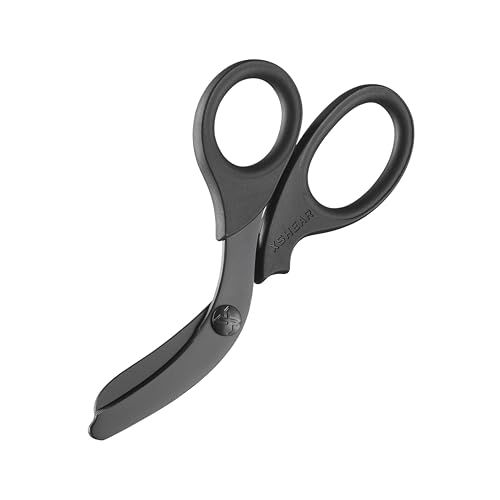
XShear 7.5, Extreme Duty
$44.00 at Amazon
Check it on AmazonPrice as of Oct 22, 2026, 3:25 AM EDT
Why it scores highest
Three shears that cut clothing fast and safely, and which one fits your kit.

As an Amazon Associate I earn from qualifying purchases.
For a first aid kit or medical bag, get the XShear 7.5: thick 420J2 blades, a blunt tip and a 5-year warranty. For a pocket, the XShear Mini. For a belt or car kit, the Leatherman Raptor Rescue folds and adds a strap cutter, ring cutter and glass breaker.

Product prices and availability are accurate as of the date/time indicated and are subject to change. Any price and availability information displayed on Amazon.com at the time of purchase will apply to the purchase of this product.
Our spec score runs every shear through the same nine checks from the makers’ own pages and listings: steel grade, an edge for tough material, a safe tip, autoclaving, warranty, sharpening, carry, rescue tools and length. The method is at the bottom of the page.
Prices and availability are accurate as of the time shown and may change.
Your shears live in a first aid kit, medical bag or IFAK, and the clothing you may need to cut is heavy: a leather jacket, winter layers or work gear.
You want your shears in a pocket all day. The XShear Mini is 6 inches long and weighs 1.55 ounces.
The XShear 7.5 is the shear we’d put in a kit bag, and it scores 9.0, the highest here. XShear builds it around one idea: thicker blades. The maker says its hardened stainless blades are twice as thick as most trauma shears, and its Amazon listing names the steel as Japanese 420J2.
The point is stiffness. XShear pairs the thick blades with a heavy-duty center bolt that its listing says won’t loosen or flex. The maker names motorcycle gear, firefighter turnout gear, heavy winter clothing and wetsuits as things it cuts.
Patient safety is the other half. XShear has a patent on the blunt tip and curved design, which it says gives a gentler edge near the skin. That’s the point of a trauma shear: as Wikipedia puts it, the wide, blunt tip is made to slide across skin while you cut clothing. The inner handles are soft-touch, for comfort and slip resistance.
Care is where it pulls ahead of the Raptor. XShear’s care page says the shears can be sanitized in an autoclave using standard instrument procedures, though they aren’t made to be sterile instruments. For deep cleaning, a Torx T15 bit takes the center bolt out. When they go dull, XShear sharpens them free if you mail them in; allow 10 to 14 days.
The warranty is 5 years, with a 90-day money-back guarantee on top. XShear designs the shears in Michigan and has them made in Taiwan. XShear also lists a national stock number for the coyote-brown version, 6515-01-702-8905.
What it gives up is carry. It doesn’t fold, and it has no rescue tools beyond the blades. XShear sells holsters for the 7.5 separately: a 1-ounce micro holster and a tactical holster with a click-in lock. It also doesn’t publish a weight. When we checked, Amazon’s seller was XShear itself, and the listing was new and in stock.
Prices and availability are accurate as of the time shown and may change.
You carry shears in a scrub pocket, a small pouch or a kit where every ounce counts, and you mostly cut clothing, tape and bandages.
You expect to cut through heavy gear often. The full-size XShear 7.5 has longer handles for more leverage.
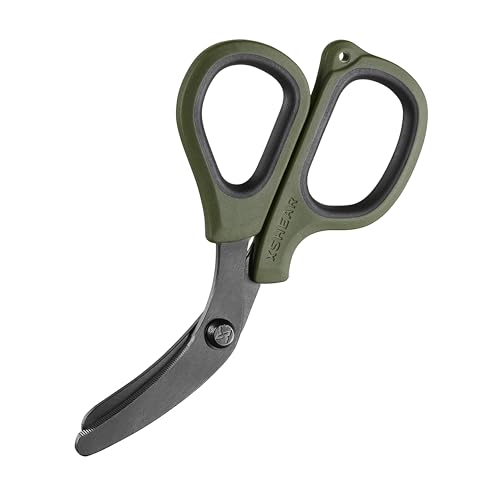
The XShear Mini scores 8.5, just under its big brother, and it’s the pick for a pocket. XShear gives it an overall length of about 6 inches with a 2-inch blade, and a weight of 1.55 ounces. That’s lighter than the 2 ounces North American Rescue lists for its standard 7.25-inch shear.
It keeps most of what makes the 7.5 good. XShear lists heavy 420J2 stainless blades, the same titanium coating with a matte black finish, the curved blade with a blunt tip, and the soft-touch, non-slip inner handles. The maker says it handles everyday cutting easily, plus heavier jobs like thick clothing, leather or boots when needed.
Length is the one place it gives up points. A trauma shear’s long handles are a lever: the farther your hand is from the pivot, the more force reaches the blade. Our length check gives full marks from 7 inches up, so the Mini earns half. For tape and dressings, you won’t notice. For a leather jacket, the 7.5 is the better tool.
Build is a little different too. The Mini has a heavy-duty rivet where the 7.5 has a removable bolt, and XShear’s care page says the mini can’t be taken apart. Clean it in place, autoclave it like the larger shear, and if cleaning and oil don’t fix a stiff action, XShear suggests mailing it in for sharpening and maintenance. Sharpening is free.
There’s a lanyard point on the handle. XShear sells two holsters made for the 6-inch Mini, a molded one and a 1-ounce micro holster, and says the Mini doesn’t fit the holsters made for the 7.5. Like the 7.5, it’s covered for 5 years with a 90-day guarantee, and it’s made in Taiwan.
When we checked, Amazon’s seller was XShear itself, and the olive drab listing was new and in stock.
Prices and availability are accurate as of the time shown and may change.
You want shears on your belt or in the car, and a strap cutter, ring cutter and window breaker in the same tool.
Your shears need to go through an autoclave. The XShear 7.5 is rated for it and can be taken apart to clean.
The Raptor Rescue is the only folding shear here, and it scores 8.0. Closed it’s 5 inches long; open it’s 8 inches and locks in place. Leatherman says the lock means no flex or give when you cut, and its Amazon listing adds that the shears lock when holstered, so you can wear them upside down on a belt.
It’s also the only pick with rescue tools built in. Leatherman lists a strap cutter, a ring cutter, a 5 cm ruler, an oxygen tank wrench and a carbide glass breaker. The ring cutter is for soft metals only: Leatherman says gold and silver, not stainless steel or titanium. That’s why it scores full marks on our rescue-tool check and why it’s the car-kit pick.
Leatherman’s spec table lists the shears as 420 stainless (its tools list says 420HC) with a bead-blast finish. Leatherman’s sharpening notes say the blade pairs a straight edge with a micro-serrated one. Its Raptor Response page says the micro-serrations on the inner blade keep fabric from slipping and binding. The handles are polyamide 6 molded over 420 stainless, with a lanyard hole and a replaceable pocket clip you can remove.
Two things cost it points. Leatherman doesn’t state a blunt or rounded tip on its page or listing, so it scores 0 on our safe-tip check, as any shear would. And its cleaning advice is mild soap and water, a dry-off and a PTFE lube on the pivot, with a warning not to take the tool apart. It publishes no autoclave rating.
Sharpening is spelled out instead of mailed in: 32 degrees inclusive on the straight edge, and only the serrated side of the micro-serrated edge, with a ceramic or diamond rod. The pivot screw can be tightened or loosened to suit what you’re cutting.
Leatherman builds it in Portland, Oregon, from USA and global parts, and backs it for 25 years. This listing includes the utility holster, as Leatherman’s own page does. It weighs 5.8 ounces, almost four times the Mini. When we checked, Amazon’s seller was Leatherman Tool Group, and the listing was new and in stock.
Every spec comes from the maker’s own pages or its own Amazon listing. Scroll sideways on a phone.
| Shear | Photo | Score | Length | Weight | Steel | Safe tip | Cleaning | Warranty | Buy |
|---|---|---|---|---|---|---|---|---|---|
| XShear 7.5 Heavy clothing and gear | | 9.0 | 7.5 in | Not published | 420J2 | Blunt, curved | Autoclave, bolt comes out | 5 years | Check it on Amazon |
| XShear Mini Scrub or pants pocket | | 8.5 | 6 in | 1.55 oz | 420J2 | Blunt, curved | Autoclave, riveted | 5 years | Check it on Amazon |
| Leatherman Raptor Rescue Duty belt or car kit | | 8.0 | 8 in open 5 in closed | 5.8 oz | 420 | Not stated | Soap and water, don’t take apart | 25 years | Check it on Amazon |
All three are trauma shears: bent-handled scissors with a flat lower blade that slides under clothing. The Raptor folds; the two XShears don’t.
Trauma shears are scissors built to cut clothing off an injured person quickly without cutting the person. Three things set them apart from kitchen or office scissors: the bend, the tip and the build.
| Feature | Trauma shears | Ordinary scissors | Why it matters |
|---|---|---|---|
| Handle angle | Bent, traditionally about 150 degrees | Straight | A longer lever arm than normal scissors |
| Tip | Wide and blunt, made to slide across skin | Usually pointed | Lowers the risk of cutting the patient |
| Build | Rugged: plastic handles, metal blades | Varies | Made to cut seat belts, leather, denim and thin metal |
| Use | External only; not for surgery | General | They’re for clothing and dressings, not wounds |
That description comes from Wikipedia’s entry on trauma shears, which also notes the trade name Tuff Cuts and that fishermen, soldiers and divers carry them as a safer alternative to a knife. Bandage scissors are the smaller cousin, made mainly for sizing and removing dressings.
In a prepper’s kit, they do two jobs. They expose an injury so you can see it and treat it, and they cut tape, gauze and dressings to size. Our IFAK guide covers what else goes in the pouch, and the tourniquet guide covers the item you’d reach for first in a bleed.
No maker publishes a standard cut test, so here is what each one claims in its own words, next to the general list from Wikipedia.
| Shear | Maker’s claim | Feature it credits |
|---|---|---|
| XShear 7.5 | Motorcycle gear, firefighter turnout gear, heavy winter clothing and wetsuits | Blades twice as thick as most, heavy-duty center bolt |
| XShear Mini | Everyday materials, plus thick clothing, leather or boots when needed | Heavy 420J2 blades |
| Leatherman Raptor Rescue | Clothing, plus straps with the strap cutter and soft-metal rings with the ring cutter | Locking shears, separate cutters |
| North American Rescue (left out) | The toughest materials | Serrated lower edge |
| Prestige Medical 87 (left out) | Tough clothing and bandages | Milled, not stamped, serrations |
| Trauma shears in general (Wikipedia) | Seat belts, leather, denim, even thin metal | Rugged construction |
Treat these as claims, not test results. What they tell you is what each maker designed for. XShear built for thickness, Leatherman for a folding tool with extra cutters, and the medical brands for a light, autoclavable shear for clothing and dressings.
The makers credit two features for heavy fabric. One is serrations: Leatherman says its micro-serrations keep fabric from slipping and binding, North American Rescue credits its serrated lower edge, and Prestige says its serrations are milled rather than stamped. The other is stiffness: XShear credits blades twice as thick as most and a center bolt that won’t loosen or flex.
The blunt tip is what makes a trauma shear safe to use on a person. Two of our picks state one; Leatherman doesn’t mention a blunt tip anywhere on its Raptor page or listing.
| Shear | Tip, as the maker states it | Steel | Edge |
|---|---|---|---|
| XShear 7.5 | Patented blunt tip and curved design | Japanese 420J2, hardened, titanium coated | Twice as thick as most |
| XShear Mini | Curved blade with a blunt tip | Heavy 420J2, titanium coated | Not stated |
| Leatherman Raptor Rescue | Not stated | 420 (420HC in its tools list), bead blast | Straight edge plus micro-serrated edge |
| North American Rescue (left out) | Rounded tip and clothing-lift lip | “Premium-grade” stainless, no grade | Serrated lower edge |
| Prestige Medical 87 (left out) | Not stated | Japanese 420 | Milled serrations |
Every steel named here is 420-family stainless. The letters after it are grades within that family: 420J2 on the XShears, 420 on the Raptor’s spec table (420HC in its tools list) and plain 420 on the Prestige. The makers don’t publish hardness figures, so we score only whether the grade is named, not which grade is better.
North American Rescue is the odd one out. It describes its steel as “premium-grade” without naming it, which is why it misses that check. It does state a rounded tip and a clothing-lift lip, and it’s the only maker here that lists a lip.
Longer handles give more leverage; shorter shears fit a pocket. Here’s each shear’s published open length.
| Shear | Open length | Closed length | Weight | Blade or shear length |
|---|---|---|---|---|
| Leatherman Raptor Rescue | 8 in | 5 in | 5.8 oz | 1.9 in shear length |
| XShear 7.5 | 7.5 in | Doesn’t fold | Not published | Not published |
| XShear Mini | About 6 in | Doesn’t fold | 1.55 oz | 2 in blade |
| North American Rescue (left out) | 7.25 in (6.25 in also sold) | Doesn’t fold | 2 oz | Not published |
The Raptor is the longest open and the shortest closed, which is the whole point of a folding shear. It pays for that in weight: 5.8 ounces against 1.55 for the Mini and 2 for North American Rescue’s 7.25-inch shear. On a belt, that’s fine. In a scrub pocket all shift, the Mini is easier to forget about.
Shears that cut clothing off an injured person need cleaning afterward, and the makers disagree on how. Follow your maker’s rule, not a general one.
| Shear | Autoclave | Take apart to clean | Sharpening | Lubricate |
|---|---|---|---|---|
| XShear 7.5 | Yes, to sanitize; not made as a sterile instrument | Yes, Torx T15 center bolt | Free by mail from XShear, 10 to 14 days | A drop of oil on the pivot, per XShear’s care page |
| XShear Mini | Yes, to sanitize | No, riveted | Free by mail from XShear | A drop of oil on the pivot |
| Leatherman Raptor Rescue | Not published | No; Leatherman says it can affect performance and warranty | Yourself: 32° inclusive on the straight edge; serrated side only, ceramic or diamond rod | PTFE lube on the pivot, after every cleaning |
| North American Rescue (left out) | Yes, 143°C / 290°F | Not stated | Not stated | Not stated |
| Prestige Medical 87 (left out) | Yes, 143°C / 290°F | Not stated | Not stated | Not stated |
For the Raptor, Leatherman’s instructions are mild soap and water, then dry the tool fully to prevent corrosion. It warns against harsh chemicals like acetone or brake cleaner, which can damage the non-metal parts. Oil all pivots whenever the action feels stiff and after every cleaning.
For the XShears, XShear allows any commercial disinfectant or bleach solution, then a water rinse and a full dry, since many disinfectants can corrode the surface. It says the shears can be autoclaved but aren’t designed or approved as sterile instruments.
Unlike Leatherman, it says 100% acetone can lift adhesive residue. For a deep clean on the 7.5, a T15 bit takes the center bolt out; XShear says to reassemble the parts in the proper order.
Pick where the shears will live and what you most need to cut. The answer uses only the makers’ published specs.
Our pick: XShear 7.5 (9.0)
Full-size leverage, a blunt tip and an autoclave rating, plus a center bolt that comes out for deep cleaning.
| Where they live | Clothing and bandages | Heavy clothing and gear | Straps, rings, windows |
|---|---|---|---|
| Scrub or pants pocket | XShear Mini | XShear Mini | Leatherman Raptor Rescue |
| Duty belt or pack strap | Leatherman Raptor Rescue | XShear 7.5 | Leatherman Raptor Rescue |
| IFAK, medical bag or kit | XShear 7.5 | XShear 7.5 | Leatherman Raptor Rescue |
| Glove box or car kit | Leatherman Raptor Rescue | XShear 7.5 | Leatherman Raptor Rescue |
| Carry-on bag | XShear Mini | XShear Mini | Leatherman Raptor Rescue |
Usually, yes. TSA’s rule for scissors in a carry-on is that the blades must be less than 4 inches from the pivot point, and the officer at the checkpoint has the final say.
Under 4 inches: allowed in a carry-on under TSA’s rule for scissors. The officer still has the final say.
| Shear | Published blade length | Carry-on, by TSA’s rule |
|---|---|---|
| XShear Mini | 2 in blade | Under 4 in |
| Leatherman Raptor Rescue | 1.9 in shear length | Under 4 in by blade; TSA has no entry for its glass breaker or ring cutter |
| XShear 7.5 | Not published | Measure from the pivot before you fly |
| North American Rescue 7.25 (left out) | Not published | Measure from the pivot before you fly |
In checked bags, TSA allows scissors of any size but asks that sharp objects be sheathed or securely wrapped to protect baggage handlers and inspectors. Keep them in a holster, or wrap the blades.
The Raptor is the one to think about. Its shears fall under the limit by Leatherman’s published shear length, but TSA’s scissors entry says nothing about the glass breaker or ring cutter. If you can’t risk losing it at the checkpoint, put it in your checked bag and fly with a Mini.
These are shears people search for. Each one missed our 7.0 floor or a basic check, so we don’t recommend them here.
| Shear | Score | What held it back | What it does well |
|---|---|---|---|
| North American Rescue ZZ-0063, 7.25 in | 5.1 | No steel grade or warranty published; no sharpening support or holster | Rounded tip, clothing-lift lip, serrated edge, O2 wrench, autoclave to 143°C, 2 oz |
| Prestige Medical 87 EMT utility scissor, 7.5 in | 4.5 | No tip design or warranty published | Japanese 420 steel, milled serrations, autoclave to 143°C |
| Prestige Medical 607 fluoride scissor, 7.5 in | 3.0 | No tip, edge or warranty published | Non-stick coating for tape, 420 steel, autoclavable |
| SOG ParaShears | Left out before scoring | An 11-tool multi-tool with 2-inch shears, a different kind of product | Folds, with many tools |
| Unbranded “Raptor-style” folding shears | Left out before scoring | No maker documents to check the listing against | Look like the Raptor for less |
North American Rescue and Prestige both rate their shears for the autoclave at 143°C (290°F), and NAR’s 2-ounce weight is the lightest published for a full-size shear here. A low score means the maker doesn’t publish the facts a home kit buyer needs, mainly a warranty and, for Prestige, the tip design. It doesn’t mean the shears cut badly.
Pocket, belt, kit bag or car. That settles size and folding.
The maker should say so. It’s what makes them safe on skin.
Serrations or thick blades for denim, leather and straps.
Autoclave, or soap and water? Will you clean them after use?
Five years or more, from a maker that sharpens or explains how.
Buy a named brand whose listing matches the maker’s page.
| Your situation | Look for | Our pick |
|---|---|---|
| Home first aid kit or IFAK | Full length, blunt tip, autoclave rating | XShear 7.5 |
| Nurse or caregiver, pocket carry | Light, short, blunt tip | XShear Mini |
| Car emergency kit | Folding, strap cutter, glass breaker | Leatherman Raptor Rescue |
| Belt or pack strap | Folding with a holster | Leatherman Raptor Rescue |
| Flying | Blade under 4 in from the pivot | XShear Mini |
| Cutting heavy work clothes | Thick blades, tight pivot | XShear 7.5 |
If you’re building one kit for the house, the XShear 7.5 is the one we’d buy. It has the safe tip stated in writing, it can be autoclaved and taken apart, and XShear sharpens it free. If the shears will ride in your car, the Raptor’s glass breaker and strap cutter earn their extra weight. Our car emergency kit guide covers the rest of that kit.
Cutting clothing off an injured person quickly so you can see and treat the injury, and cutting tape, gauze and dressings. The blunt tip slides along the skin while the blades cut. Wikipedia notes they’re for external use only, not surgery.
Trauma shears are bent, traditionally at about 150 degrees, which gives a longer lever arm. They have a wide, blunt tip made to slide across skin and are built to cut denim, leather and seat belts. Ordinary scissors are straight and usually pointed. Bandage scissors are a smaller version for dressings.
In a carry-on, TSA allows scissors with blades less than 4 inches from the pivot point, and the officer has the final say. In checked bags any size is allowed, sheathed or wrapped. The XShear Mini’s 2-inch blade is well under the limit.
Depends on the maker. XShear says its shears can be sanitized in an autoclave but aren’t made as sterile instruments. North American Rescue and Prestige rate theirs to 143°C (290°F). Leatherman says to clean the Raptor with mild soap and water and publishes no autoclave rating.
Follow the maker. XShear sharpens its shears free if you mail them in. Leatherman says to sharpen the Raptor’s straight edge at 32 degrees inclusive, and the micro-serrated edge only on its serrated side with a ceramic or diamond rod.
Not the blades. The Leatherman Raptor Rescue has a separate ring cutter, and Leatherman says it’s for soft metals only, such as gold and silver, not stainless steel or titanium. None of the other picks has a ring cutter.
If you want shears that fold, ride on a belt and carry a strap cutter, ring cutter, O2 wrench and glass breaker, yes; it scores 8.0 with a 25-year warranty. If you need to autoclave your shears, the XShear 7.5 scores higher at 9.0.
Wikipedia says the blade is traditionally bent at about 150 degrees, which gives a longer lever arm than normal scissors. A longer lever puts more force at the blade for heavy clothing like denim and leather.
Plain Prepper is owned and edited by Isaac Daniels. Every spec on this page comes from the maker’s own product and care pages or the brand’s Amazon listing, and the travel rule from TSA, named in the sources below. We don’t run cutting tests, so we never present a result as measured by us.
Prices and photos come from Amazon and show the time they were read.
We read nine facts from each maker and put every shear through the same table below. Weighting those lines gives the score out of 10. Customers’ stars and cutting tests play no part.
Where a maker doesn’t state a feature, it scores 0 on that line. That’s why the Raptor gets nothing for a safe tip: Leatherman doesn’t state one. XShear’s care page covers all its trauma shears for the autoclave and the 5-year warranty, the Mini included.
| Check | Weight | How it’s scored |
|---|---|---|
| Steel grade named | 10% | 10 if the maker names the steel grade; else 0 |
| Edge for tough material | 15% | 10 if the maker names serrations or thicker, heavy blades; else 0 |
| Safe tip stated | 15% | 10 if the maker states a blunt or rounded tip; else 0 |
| Autoclave published | 10% | 10 if the maker says it can be autoclaved; 5 for washing instructions only |
| Warranty | 15% | Warranty years ÷ 5 × 10, up to 10; 0 if none is published |
| Sharpening support | 10% | 10 if the maker sharpens them or publishes how; else 0 |
| Carry | 10% | 10 if it folds or a holster comes in the box; 5 if the maker sells a holster that fits |
| Rescue tools | 5% | Share of four: strap cutter, ring cutter, O2 wrench, glass breaker |
| Length for leverage | 10% | 0 at 5 in open, rising to 10 at 7 in or longer |